Make Haste Slowly

Back in February 2023, I was researching the debates around the Korean Financial Services Commission's security token offerings guidelines when I came across a striking image among the search results at the Law Times (법률신문).
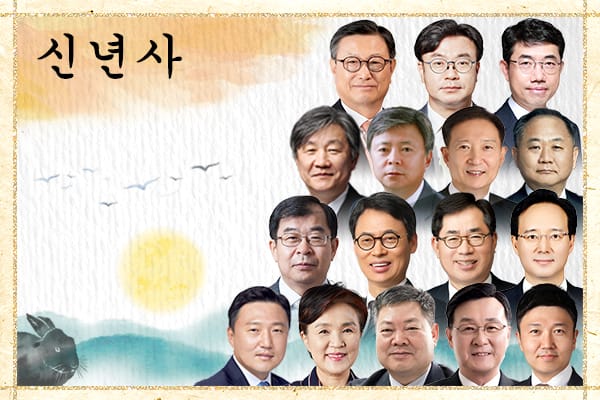
Arrayed in a collage titled "New Year's Greetings" were photos of the heads – and heads only – of the managing partners of Korea's "sixteen major law firms."
It gave me the impression of seeing, in section of bleachers, a sea of cardboard cutouts of favorite team members held aloft by their fans. And it gave me a different kind of at-a-glance view of Korean Biglaw.
To that point, I'd have associated that type of survey with trend reports, books, or network databases. The image I'd have in my head for articles about the 'leaders of the X major firms' would be composed a lot more like this one. Perhaps more fundamentally, and particularly as someone not working directly in the Korean legal market, I'd have cobbled my picture of it together asynchronously.
The Law Times' collage offered another way of seeing.
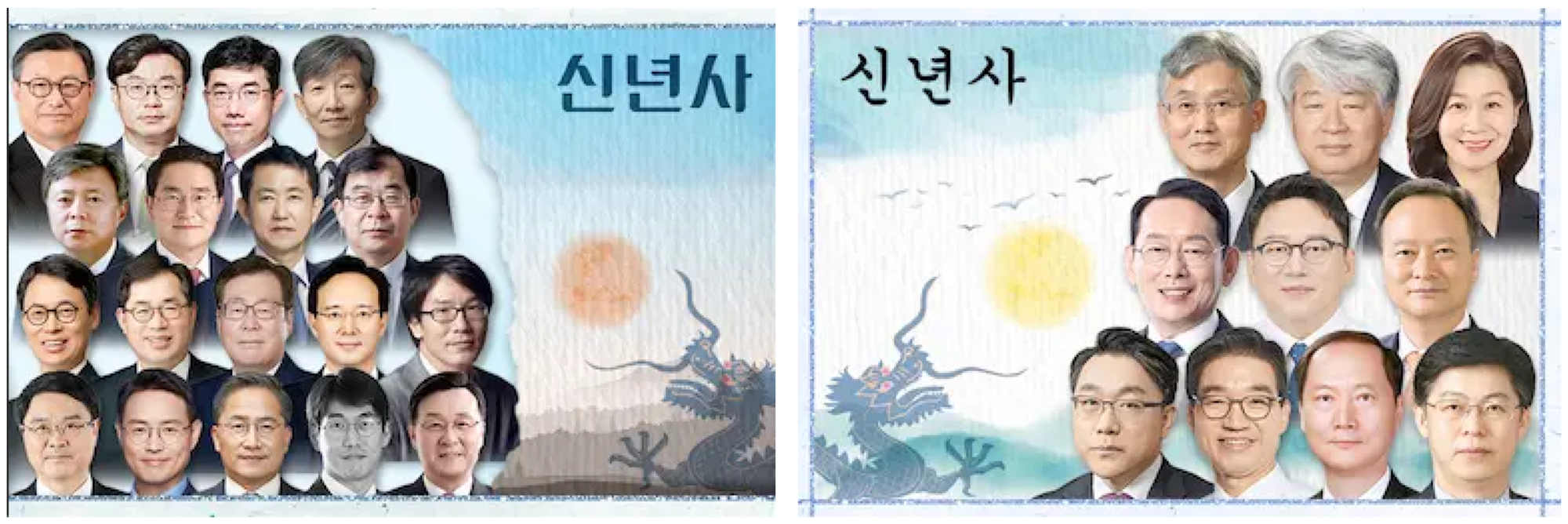
So as 2024 dawned, I was happy to open the paper and find that it had continued not just the feature (which, I learned, brings readers greetings from across Korea's legal public sector and professional associations in a twin article), but the design to boot.
It's gripping.
The archetypical 'leaders assembled' photo feels like the meeting's already over. Like you've missed it. Like you weren't invited. Snapped from the distance required to fit everyone in the frame (all the more of a task given the shoulder-to-shoulder/space-in-between, demands of the occasion), it holds you at a remove. You have to gaze up at them, your eye level their shoes, and traverse a dark expanse of suits before getting to faraway faces. A stage and a banner subsume them; that's the message.
But here, you meet everyone's gaze, and everyone meets yours. You can't but feel like you're in conversation.
The format of the written features reinforces this impression. Through some miracle of coordination, everyone's stayed on point, with messages of roughly equal length, as though Law Times had circulated a sheet of 원고지. You're not puzzling together the statements over multiple days' multiple panels, or across multiple media. You don't require high level concluding remarks, nor are they furnished. It's just you and them at the fireside, chatting.
It's a researcher’s dream. [1]
Some questions form at first sight. You can chart the profiles across the standard variables, including the "class of" markers of signal importance in the Korean legal field. I imagine that somewhere, somebody has. You can wonder about placement order. (Here, Law Times has anticipated your question, and since 2023 led with a methodological banner explaining that "there is no clearly defined criteria for the order in which New Year's Greetings appear, so we've used the number of domestic lawyers in each firm as of [late December the year prior] as a criterion." No such banner appears on the corresponding Heads of the Legal Public Sector & Professional Organizations pieces.) You might be curious about the structure and processes by which each firm is managed.
And, tracing faces and names both familiar and new through the years, you might wonder about change over time. [2]
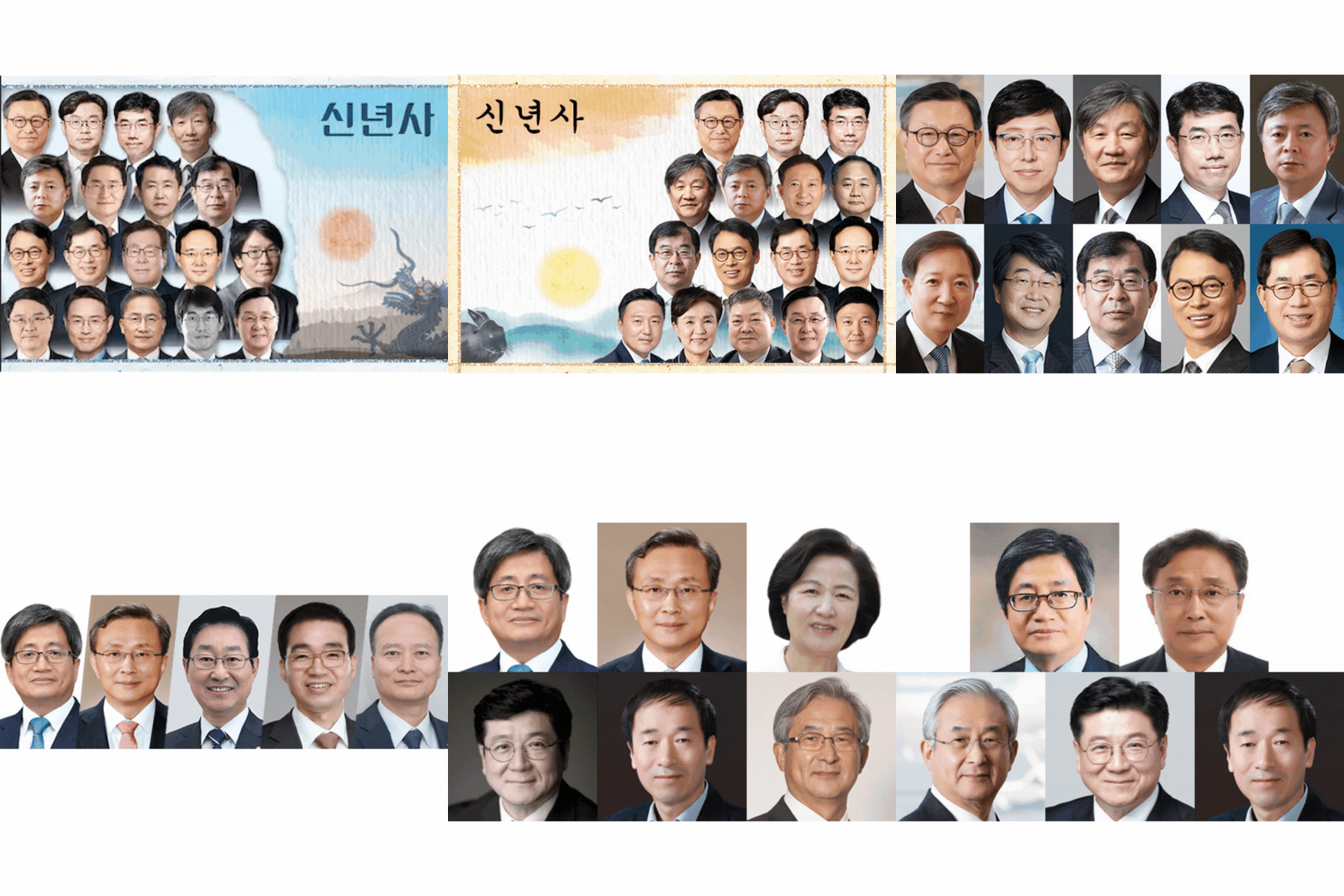
Other questions arise in reading. What are these leaders concerned about? How do they see and describe the law, and their roles in it? What do they share, and what texture can be discerned from each person's writing? To what extent does it map onto the institutions they represent? The Law Times' feature divides the legal world into representative firms on the one hand, and public sector entities and professional associations on the other. [3] Is this reflected in the nature of each's comments? And how, if at all, has this changed year to year?
As far as I can tell, the Law Times has been running this feature since 2019. And as you might imagine, New Year's messages from across the legal world have come in many forms over time. Through letters, speeches, interviews, and press conferences, the firms, courts, agencies, and associations featured produce their own, extended, New Year's messages – often more than one. So there's no shortage of sources for interested readers to delve into. [4]
Just to get us started, here's a table of some salient data in the series.
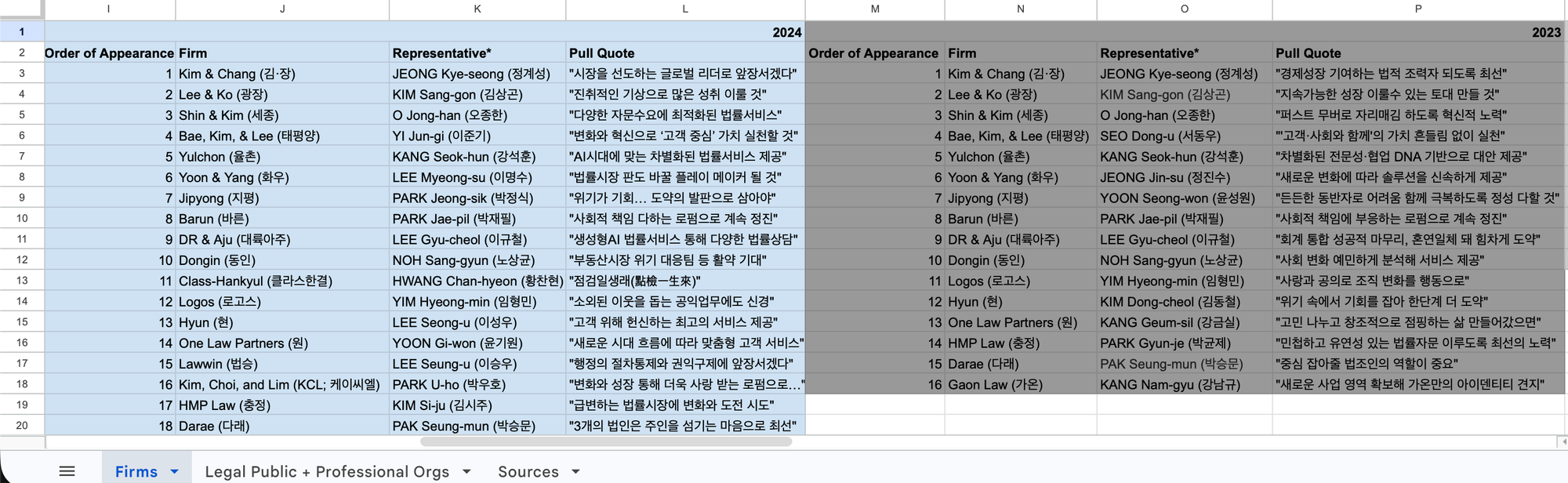
Those tuning text analytics tools may enjoy running the corpus year over year, entity by entity, and so on. Even without them, the marked expansion in the series' participation in 2023-2024 (16-18 firms vs. 10-12 in years prior; 10-11 public sector and professional organization vs. 5-6 in years prior) is immediately clear. Less clearly meaningful, but nevertheless interesting, is the sequential precedence of the public sector + URLs over the firm URLs in 4 years out of 6.
But, as I mentioned, one of the joys of this series is the human connection it forges and sustains. And to that point, a few things have stuck with me as I've read and returned to them.
One is that, by putting everyone on the same page, with roughly the same room with which to communicate, and around the same occasion, the series resembles a corporation's group interview – not with clients alone, but with the broader set of stakeholders in law and society. [5]
As such, certain formulas for expression – riffs and musings on the sexagenary cycle, reflection and projection, well wishes, reiterations of shared values – quickly come to the fore. And yet, testament to these top legal professionals' mastery of documentary format, so too do the personalities, beliefs, and organizational cultures of the writers. Some draw heavily on classical allusions or lean into extended metaphor. Some move to couplets. Some return explicitly to a particular organizational or even professional “way” each year; others do so implicitly, or even stress sea change. They share the new year's dawn light, and yet reveal in it different shades:
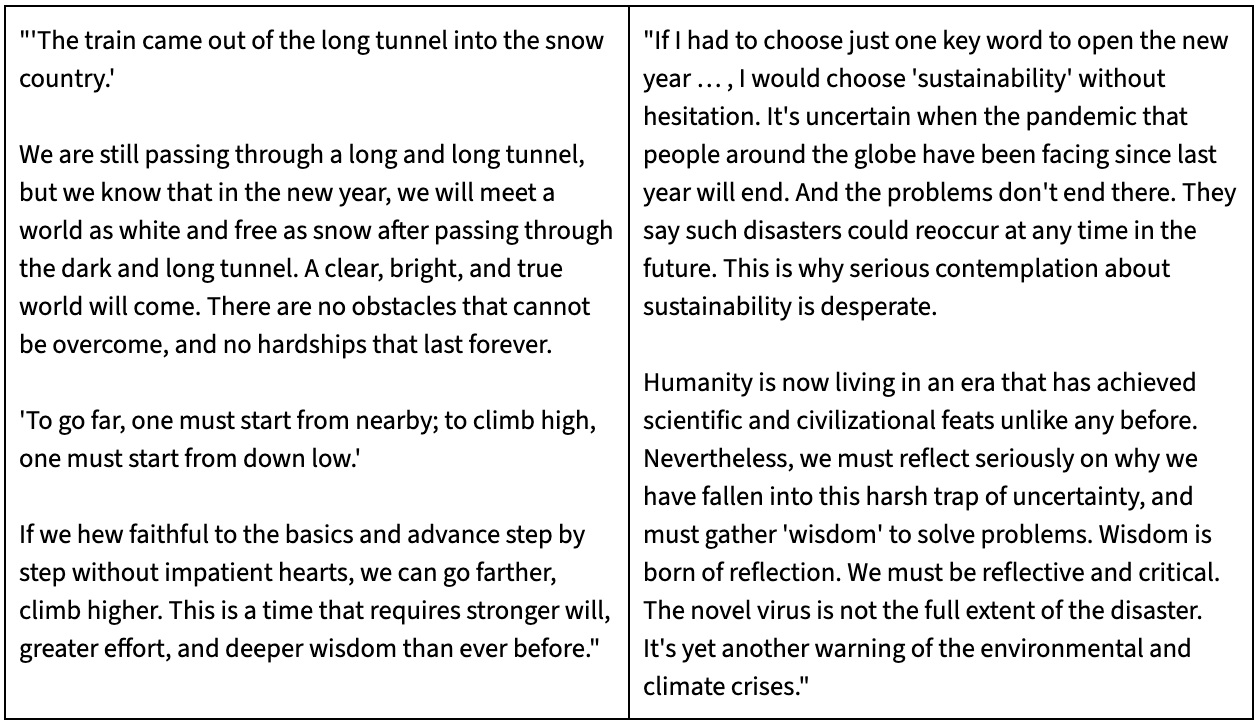
Related is the convergence and divergence in thinking on the legal profession within Korean society.
Messages in 2019, 2020, and 2022 assayed trying years in that relationship, and I wish I knew how the series was read back at launch. In the COVID era, as the relief at simply making it through 2020 gave way to an accounting of the prolonged pandemic and dangerously shifting sands of the "New Normal" a year later, in turn to describe the mounting costs of global inflation, wars, political uncertainty, and loss of faith in public institutions in the years following, messages reflected on their field's role in alleviating suffering. Writers were broadly aligned on a sense of "partnership" with society, premised on a trust continually earned (and, in some cases, on love). But what form did that partnership take?
Some described "shared joys and sorrows," a general sense of "being in/getting through it together," and even, as above, an underlying and common human fate. A number invoked national unity. And, as one writer put it, "[f]or some time now, there have been only 'my side' and 'your side,' with no 'our side.'"
Still, "together" takes on different meanings based on the context, and in many of the messages, comes at a slight remove. [6] The field "coexists" with society. The legal community is a "collective contributing to society" (emphasis my own). And "the legal community is no exception." It is not necessarily that you think, breathe, and act with clients, but rather that you do so "with clients at the center." In establishing "our side," it is legal professionals who must "act to restore the balance."
This is not to say that there is a disconnect. Rather, it speaks to the idea of an legal profession, for which "independence and autonomy" are prerequisite and which must "first fulfill a fundamental duty of being a bright mirror hung aloft" in order for "the basic foundations of all aspects of a society to remain solid and unmoving."
And what was the field to do in manifesting this partnership?
Some messages looked, again and again over the years, to underserved "neighbors" within society and to "first extend[ing] our hands to raise those who have fallen to the edge of disaster and suffering, accepting that multiple different perspectives of viewing the world can exist together." Some looked within, "standing before this question like a mirror," or "reflecting on whether we have neglected our social responsibilities while chewing over whether we are 'making mistakes without correcting them'."
Many stressed "sensitively analyzing social change" and responding expeditiously on behalf of stakeholders. Whether this would take the form of "digging three burrows to prepare for unforeseen dangers" or "creative leaping"/"quantum jumping", "lifting anchor" with a "bold ‘spirit of challenge'" or "grinding an axe to make a needle", "watching like a tiger, walking like an ox" or "having moved through last year with the steady steps of an ox, in the new year ... advancing proudly with a tiger's stride," well, that depends.
And then, of course, there is "rule of law."
Painful final moments of 2024 have cast the series' 2023 expansion in another light, as a number of that year's newly-included offices now dominate the news cycle. The 2023-2024 messages of the Prosecutor General, Minister of Government Legislation, Minister of Justice, and President of the Korean Bar Association read differently now than when I first encountered them, while consider that from the Corruption Investigation Office (CIO), we heard in January 2023 that:
The CIO, born in the Year of the Ox, may appear somewhat slow in your eyes, but please consider that we are moving carefully with tiger-like eyes ("watching like a tiger, walking like an ox"), and I believe the day will come in the near future when we will leap like a rabbit. ... All members of the CIO will not forget the mission and duty entrusted by the people, and while maintaining political neutrality and operational independence, we will move forward like an ox – steadily and slowly hurrying – to ensure the CIO becomes well-established as a new institution within the constitutional order. [7]
Among the messages in which I took heart then as now was that of the Constitutional Court:
In 2024, the Constitutional Court faces a time requiring change for new advancement. We will take steps toward change based on our accumulated experience and achievements.
There is a Latin saying, 'make haste slowly.' This aligns with the Korean wisdom of 'take the long way when in a hurry.' We will proceed deliberately but steadily to faithfully fulfill the mission entrusted to us by the people through the Constitution.
Although it took me some time to place, it dawned on me eventually that I had seen that saying before, and that despite my own narrow-sighted scurrying about in college years, the accumulated experience and deliberate effort of those before me had carved it somewhere in consciousness, a tool, a mirror.

[0] Quotes are often modified machine translations.
[1] At least a few others think so as well. In one message, a writer shares that "[i]t's been exactly 17 years since I started my career as a lawyer, and I feel proud to have become the managing partner of a law firm able to write a New Year's message in the Law Times, though I don't know how time has passed so quickly." And as I chipped away at this earlier in 2024, I was amused to learn that an episode of the popular variety show You Quiz on the Block featured a guest who, despite being a member of the self-described "ill-fated 2008 freshman class" (as it pertained to the cycles of the Korean job market), had within six months, during a terrible recruitment cycle, managed to win offers from fifteen top companies. Among his secrets? Studying companies' new year messages.
[2] And you should! To the last two points, just eyeballing the collages would fail to alert you to the fact that many of these firms have multiple managing partners; a change in the featured representative from year to year is not necessarily a change in leadership, but rather, just another MP's turn. See, e.g., Hyun, and One Partners in 2023-4.
[3] To be fair, this could be out of considerations of space. These are already quite lengthy -- and burgeoning -- articles.
[4] That said, a healthy dose of discretion and imagination alike are in order for those using only this particular corpus. Notes above have hinted at a few reasons, and, as anyone who has collected and compiled responses from multiple parties knows, all things are possible in such a process.
[5] Who do participants see as their audience? Forms of address vary: broadly "[fellow] legal professionals," "my family here in the legal profession," "citizens," and "Law Times readers" (which I had initially wondered whether comparatively impersonal but, upon reflecting on my own position, whose inclusivity I have come to very much appreciate), with many permutations ("fellow colleagues, seniors, and juniors in the legal profession"). In a few cases, content suggests a narrower or broader read.
[6] In one message, a member of the judiciary shared the perspective of having left and returned to the court: "The world I experienced outside the court had changed remarkably. In economics, society, and culture, our country has truly established itself at the center of the world. But within our society, large and small conflicts have intensified, and dissatisfaction with unfairness and inequality continues to grow."
[7] The CIO also stated: "Furthermore, under our motto of 'serving the people, upholding justice, and rewriting integrity,' we aim to create a new culture of investigation and prosecution that does not neglect due process and human rights protection while always checking whether we meet the standards of our sovereign citizens, with passion, responsibility, and a balanced approach, rather than following existing investigative agencies’ practices in our case handling and dispositions."
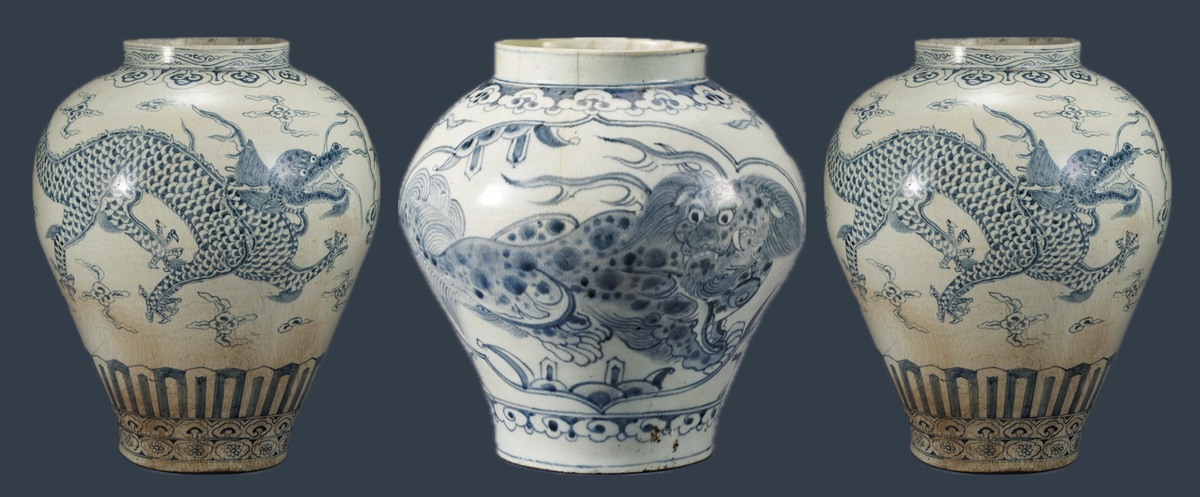
Images, in order of appearance, are (i) White Porcelain Jar with Dragon and Clouds (Item No. Deoksu 4703), and (ii) White Porcelain Jar with Haetae (Item No. Geonhui 1572), both of the National Museum of Korea. The collaged (iii) Heads of Major Law Firms and (iv) Heads of the Legal Public Sector (Key Courts, Committees, Agencies, Public Corporations, and Associations) are the preview images for their respective Law Times articles, linked in the tracker above. "Festina Lente" (v) appears on and at Yale University Library.